
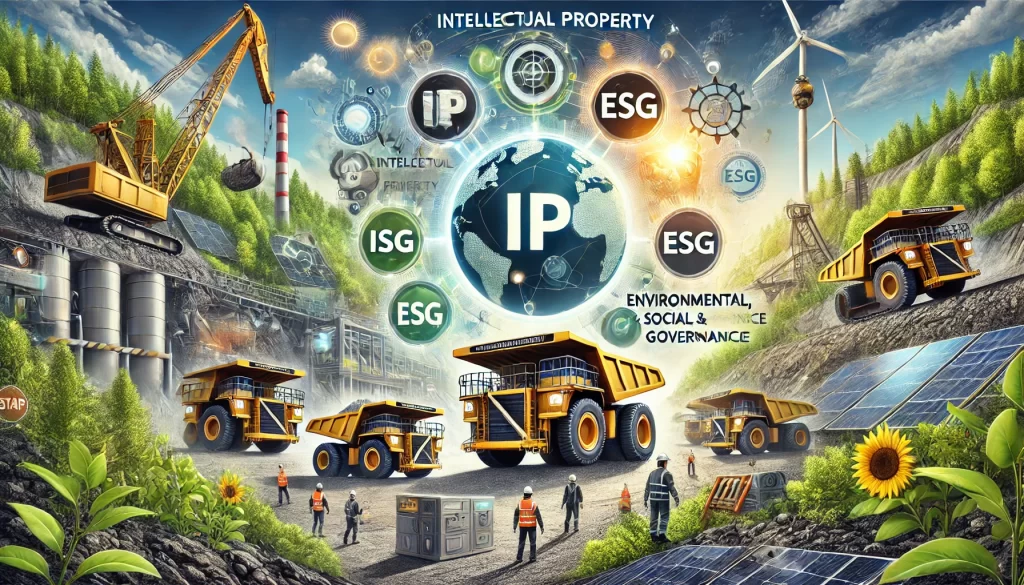
In today’s business landscape, sustainability isn’t just a buzzword—it’s a must for companies across all industries, and the mining equipment sector is no exception. As pressure mounts from investors, regulators, and the public, companies are leaning into Environmental, Social, and Governance (ESG) frameworks to show they’re committed to doing business responsibly. But what’s often overlooked in this conversation is the powerful role that Intellectual Property (IP)plays in helping these companies meet their ESG goals.
From patented technologies that reduce environmental impacts to innovative safety systems that protect workers, IP is shaping the future of mining equipment—and it’s doing so with sustainability in mind.
How IP and Environmental Impact Go Hand-in-Hand
One of the most exciting ways IP is making a difference is in the environmental space. We’re seeing mining equipment manufacturers lead the charge with electric and autonomous vehicles that slash carbon emissions. Take companies like Caterpillar or Sandvik, for example—they’re not just making heavy machinery; they’re developing the next generation of electric mining trucks and autonomous systems that are safer and far more energy-efficient.
This is where patents come into play. By securing exclusive rights to these cutting-edge technologies, companies are able to not only protect their innovations but also showcase them as part of their commitment to sustainability in their ESG reports. This is a win-win: great for the planet and great for business.
Innovation for Social Responsibility: Protecting Workers and Communities
When we consider social responsibility—another critical component of ESG, worker safety has to be a top priority as mining is inherently risky. We’re seeing incredible advancements in autonomous systems and wearable tech that are reducing accidents and protecting workers on the job. Many of these technologies are covered by patents, giving companies a competitive edge while also demonstrating their commitment to social sustainability.
But it’s not just about workers. IP-protected innovations are also helping minimize the impact of mining on local communities. For instance, technologies that reduce dust or noise pollution are making life better for people living near mining sites. Companies that focus on these kinds of social improvements can highlight them in their ESG reports, proving that they’re about more than just profits—they’re about people.
Governance and Ethical IP Management: The Overlooked ESG Hero
When it comes to governance, how companies handle their IP is a huge part of the equation. Ethical licensing practices and transparent IP management can boost a company’s reputation, especially in an era where transparency is everything. Companies that license their eco-friendly technologies or enforce their patents to prevent counterfeiting are sending a message: We play fair, and we care about doing business the right way.
In fact, including IP management practices in ESG reporting is becoming more common as companies show how their innovations align with ethical governance. This not only keeps investors happy but also helps companies build long-term trust with their stakeholders.
Challenges on the Horizon
Of course, no good story is without its challenges. Balancing profitability with sustainability can be tricky. Do companies share their IP to promote widespread environmental benefits, or do they hold onto it to protect their competitive advantage? And then there’s the issue of verifying all those sustainability claims—audits and third-party verifications can be resource-intensive but are increasingly necessary.
Despite these challenges, the benefits of aligning IP with ESG goals are clear. Companies that can do both will be in a prime position to attract investors, enhance their brand reputation, and ultimately drive long-term success.
Let Us Therefore Hear the Conclusion of This Matter: Why Do IP and ESG Matter?
In the spirit of King Solomon’s wisdom, we might ask, What then shall we say about these things? In a world driven by rapid technological change and pressing sustainability needs, why do Intellectual Property and ESG matter?
Like Solomon, who sought wisdom to discern what was truly valuable, we too must consider the lasting impact of our innovations. It’s not just about creating the most advanced mining equipment, but about ensuring that these innovations serve a greater purpose—protecting the environment, safeguarding lives, and doing business with integrity. IP provides the tools to innovate, while ESG offers the moral compass to guide those innovations toward a sustainable and ethical future.
In the end, the intersection of IP and ESG is more than a business strategy; it is about leaving behind something enduring—a legacy of responsible progress that benefits both people and the planet. This, surely, is the wisdom for our time.
Would love to hear your thoughts—how do you see IP and ESG converging in your industry?